Light sensing, absorption, and derived metabolism in photosynthetic organisms
Photosynthesis Team
Published on 17 November 2025
Body text 1
 Team Leaders
Secretary:Tiffany Guyonnet
Team Leaders
Secretary:Tiffany Guyonnet Phone: +33 (0) 4 38 78 04 80
Presentation The Light, Photosynthesis & Metabolism (LPM) team (founded in 2015) belongs to the Cell & Plant Physiology Laboratory of the Interdisciplinary Research Institute of Grenoble.
The main research focus of the team is to understand the adaptive responses of phototrophs to different trophic lifestyles (phototrophy, mixotrophy, symbiosis) and environmental constraints.
The main models are the microalgae Phaeodactylum (diatom), Galdieria (rhodophyte), Phaeocystis (Haptophyte), Chlamydomonas (Chlorophyte), and the plant Arabidopsis.
The main approach is the ‘next-generation physiology’ that combines
photophysiology with
integrative metabolism at different scales, from the cell to the protein level.
We are a multidisciplinary team with complementary skills (molecular biology, imaging, biochemistry, modeling) and different backgrounds (eco-physiology, cell biology, biophysics, mathematics).
The LPM team belongs to the CEA (French Alternative Energies and Atomic Energy Commission), the CNRS (French National Centre for Scientific Research), the INRA (French National Institute for Agricultural Research) and the University of Grenoble Alpes.
The LPM team collaborates with many teams in France and abroad.
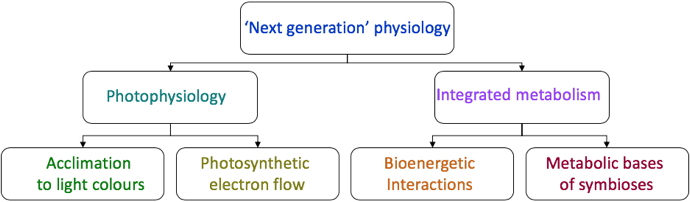
1. Acclimation to light colours
Sunlight is a substrate for photosynthesis, a developmental signal and a harmful energy source; Using the chlorophyte
Chlamydomonas reinhardti, we study the link between these light functions, studying responses to UV-B light
via genetics, molecular biology, biochemistry, bioinformatics and biophysics approaches.
2. Photosynthetic electron flow
Photosynthetic organisms need to plug light energy fluxes to the needs of the Calvin Benson cycle, by adjusting the rate of electron flow. We test the hypothesis that ion fluxes (K+ and H+) do this job by altering the proton motive force (PMF), which in turn controls light energy conversion, electron flow and ATP synthesis.
3. Bioenergetic Interactions
Optimizing the ATP/NADPH ratio is mandatory for CO2 assimilation in plants and marine phytoplankton. Plants do this
via chloroplast-localized ATP-generating processes (cyclic electron flow), while diatoms -ecologically successful phytoplankton members- have adopted energy exchanges between plastids and mitochondria. Is this mechanism a paradigm for optimization of photosynthesis in the ocean?
We are generating knowledge which, in particular in the case of unicellular microalgae, can also be exploited for domestication (growth in photobioreactor, production of metabolites of economic interest). (See industrial partnerships)
The team gathers scientists from different countries (France, Greece, Italy) complementary skills (molecular biology, cell biology, biochemistry, biophysics) and research backgrounds to study fundamental biological questions with a truly multidisciplinary approach.
The Photosynthesis team collaborates with many teams in France and abroad.
Research themes
Top page