The development of multicellular organisms depends on a delicate balance between gene activation and repression, which is controlled by
epigenetic marks* on chromatin. In plants, this regulation is essential for coordinating key developmental stages, such as flowering.
For the first time, a consortium of researchers from
CEA-Irig (LPCV &
IBS), in collaboration with the iGReD and the Institut Curie, has demonstrated that the ULTRAPETALA1 (ULT1) protein performs a dual role as a gene regulator. Known for activating the expression of certain genes (trxG function), ULT1 can also act as a repressor by directly interacting with enzymes of the
PRC2* complex (PcG function), thereby functioning as a switch for developmental genes. This discovery makes ULT1 the first bivalent factor identified in plants, capable of acting directly as a cofactor of the PRC2 complex. It identifies a key player that determines the outcome of the “tug-of-war" between the trxG and PcG functions, enabling reproduction by inducing flowering and floral morphogenesis at the most favorable time.
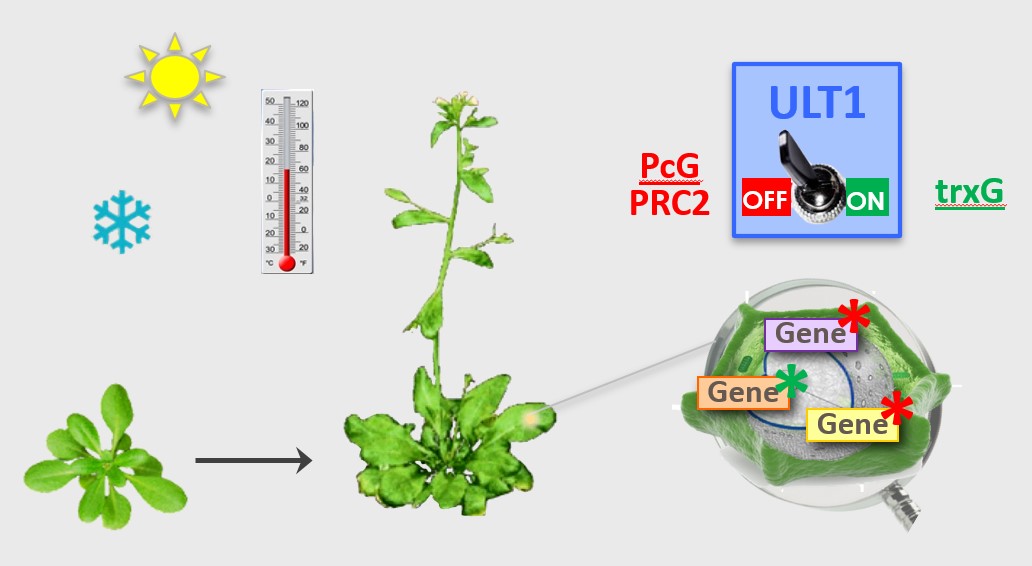
© CEA-Irig/LPCV/ChromDev/C. Carles
Figure: The ULTRAPETALA1 chromatin switch finely regulates key developmental transitions involved in reproduction (flowering) by acting on the Polycomb (PcG PRC2) and Trithorax (trxG) protein complexes.
The discovery of this new mechanism sheds new light on how plants regulate their flowering and could, in the long term, facilitate the development of biotechnological approaches aimed at enhancing crop resilience to environmental changes.
morphogenesis*: set of processes that lead to the formation and organization of the flower’s various organs.
epigenetic marks*: chemical groups attached to DNA or to the histone proteins associated with it. These marks can influence gene accessibility and modulate gene transcription.
PRC2*: Polycomb Repressive Complex 2, a protein complex that acts as a molecular switch by repressing the expression of certain genes through modifications to chromatin structure (a complex of DNA wound around histones; its degree of compaction regulates access to genes).
UMR : CEA, CNRS, INRAE, Université Grenoble Alpes (IRIG-LPCV ;
IBS).
Fundings : ANR (projets ChromFlow ANR-10-JCJC-1206 et ChromSwitch ANR-22-CE20-0038), Chaires d'excellence CNRS-UJF puis Initiative UGA, Ambassade de France en Allemagne, Marie Curie IEF (FP7/2007–2013), Programme Impulsion et Allocation Doctorale de Recherche CEA-DRF, Labex, Idex et Ecole de recherche CBS-EUR UGA (ANR-10-LABX-49-01, ANR-17-EURE-0003).
Collaborations : Institut Curie (Paris), Universités de Montpellier, Clermont Auvergne, Regensburg (Allemagne).