Many biological processes depend on the coordinated activity of proteins that directly interact to form physiologically active complexes. Until recently, experimental structural studies have often focused on individual domains, single proteins or only a few protein partners. New AI methods including Alphafold,
RoseTTAFold* and
ESMFold* allow the prediction of not only the fold of single proteins, but also of multi-protein complexes. Nevertheless, bottlenecks remain in using experimental protein interactome data for the reliable prediction of large protein complexes.
In this study, performed in collaboration with researchers from the
CEA-Irig/LPCV and the ESRF, a structure prediction pipeline, called
Alphafuser, was developed. This new tool, based on Alphafold, combines experimental protein-protein interaction data with a systematic testing of all different combinations between protein partners up to a user defined complex size. In order to limit the computational time required to query all possible combinations,
Alphafuser progressively eliminates low scoring and low probability complexes based on confidence scores called the interface predicted template modelling (ipTM*) score. The pipeline was parameterized using used known multiprotein complexes as a training set.
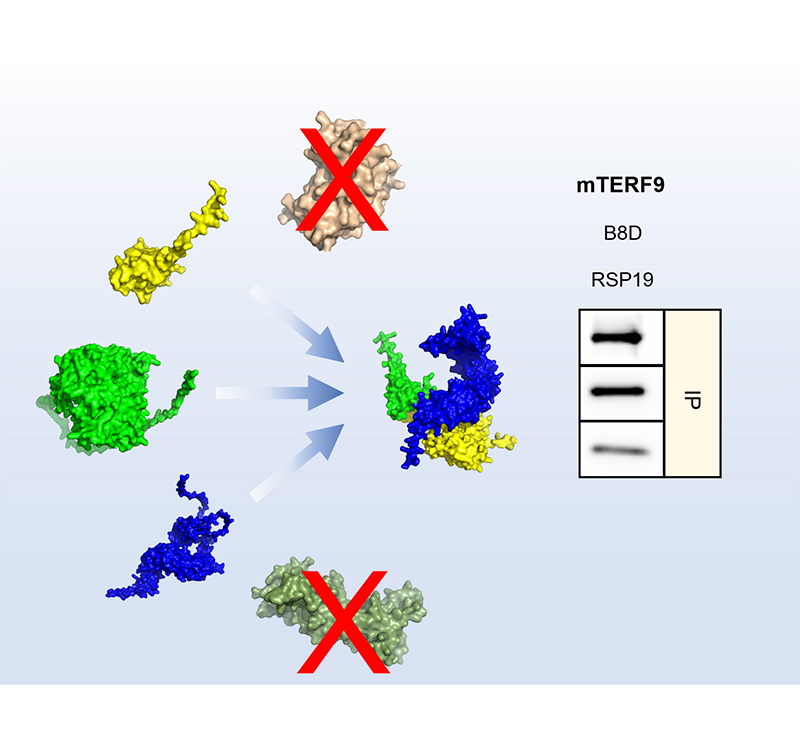
Alphafuser was applied to experimental protein interactome data lacking experimental structural characterization and the results were validated by
pull-down*, confirming the predicted protein complexes found by the
Alphafuser pipeline.
© CEA-Irig/LPCV/StrucDev/S. Hutin
Figure:
Alphafuser prediction of protein partners interacting with mTERF9, a protein involved in the regulation of RNA metabolism and gene expression, experimentally validated by pull-down assays.
In silico protein fold and protein complex prediction is a major advance in structural biology. As methods for determining protein interactomes develop, tools such as
Alphafuser will become powerful complementary ways to systematically explore protein-protein interactions and to rank putatively important protein complexes for downstream experimental validation and study.
UMR : LPCV UMR 5168 - CNRS, CEA, UGA, UMR 1417 INRAE.
Fundings : Agence Nationale de la Recherche (grant No. ANR-23-CE20-0019 to Chloe Zubieta, Kamel Hammani).
Collaborations : IBMP, Strasbourg ; ESRF, Grenoble.