Chirality — the property of having a ‘right’ or ‘left’ orientation — is a fundamental feature of living systems found at all scales, from molecules to whole organisms. At an intermediate scale, cells that interact within a group can also adopt a collective behavior that reveals this characteristic, exhibiting a biased motion in a given direction. Studying the mechanisms underlying this organization therefore constitutes an essential step toward understanding the properties that govern organismal development.
This study explores the chirality of moving cells, that is, their tendency to preferentially migrate to the right or to the left. By confining groups of cells containing progressively fewer cells, we showed that just two cells are sufficient to generate chiral motion: like a pair of dancers, they spontaneously rotate around one another in a preferred direction. By modulating the traction forces exerted by the cells on their substrate, we established that the direction of rotation depends on the level of force produced by the pair. By forming a duo in which one cell is more contractile than the other, we also discovered that the cell exerting the greater force orchestrates this choreography.
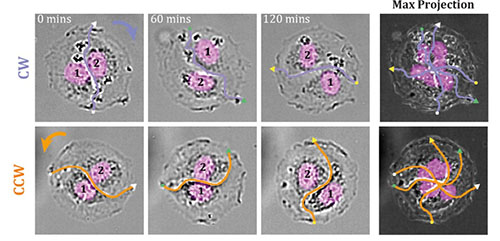
Time-lapse image sequence showing a pair of cells rotating to the right (CW) and a pair rotating to the left (CCW). A colored line marks the junction area between the two cells. On the right side of each time-lapse sequence, an overlay image of the pairs at different time points is shown.
© CEA-Irig/LPCV/CytoMorphoLab/Ghina Badih & Laetitia Kurzawa
This study shows that the mechanical properties of individual cells within a collective can influence the function of the group. It also raises a fundamental question: what is the mechanism that leads a cell to adopt a preferred direction?
Fundings
ANR chirality (ANR-20-CE13-0004) & ARC (ARCDOC42022120005746).